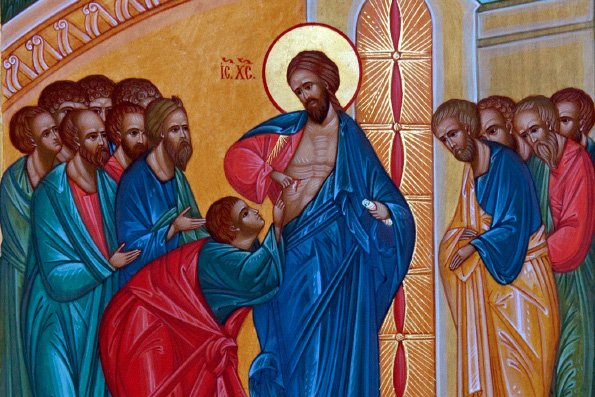
Any discussion of the Paschal season, that is, the season our Church's liturgy presents to us following the Feast of Pascha, presupposes an understanding of its purpose and requirements. This, in turn, requires an awareness of the season that prepared us for it: Great and Holy Lent.
Without delving into excessive detail, those familiar with Church history know that Great Lent was shaped by several historical factors. Among these was the reception of catechumens, who were Jews and pagans that had come to believe in Christ as Lord and Savior, into Church membership, specifically during the liturgy of Holy Saturday. It is well-established that the Church selected the themes for the Paschal season, particularly the Gospels of the five Sundays following the Feast and preceding its leave-taking, to define for those newly illumined by Baptism what God expects of them in serving this darkened world. In other words, liturgically speaking, Great Lent is pregnant with the Paschal season.
Thus, the service required of the baptized is revealed through these five Sundays: Thomas Sunday, the Sunday of the Myrrh-bearing Women, the Sunday of the Paralytic, the Sunday of the Samaritan Woman, and the Sunday of the Blind Man. I speak of the service of "the baptized" in the singular, and I trust the discerning reader will note that each Gospel narrative read during this period, with the exception of the Myrrh-bearers’ account, features a central individual. This points to the personal nature of Baptism, which each of us receives individually. And though we exclude the Sunday of the Myrrh-bearing Women from this specific pattern, it does not mean it is devoid of baptismal references. This Sunday, on which we also commemorate Joseph of Arimathea and Nicodemus (who were disciples of the Lord secretly or by night, as noted in John 19:38-39), is redolent with the fragrance of Baptism. For in its Gospel passage (Mark 15:43-16:8), we see a young man clothed in a white robe, which is the robe of Baptism. We see the empty tomb, which is Christ’s tomb and, indeed, all our tombs as well. We speak of "our tombs" in the context of Baptism because Baptism, as a participation in Christ’s death and resurrection (Romans 6:3-5), qualifies us to understand, with true realism, that "there is no one dead in the tomb," as Saint John Chrysostom proclaims in his Paschal Homily (cf. Matthew 27:52-53).
A profound meaning of the Paschal season is that these Gospel texts place before us ordinary individuals upon whom the light of Pascha shone, though they were undeserving. Thomas doubted the Lord’s Resurrection, then believed. The Paralytic and the Blind Man were considered, by their society, as sinners rejected by God. The Samaritan Woman, according to official Jewish thought, was an outsider whose ancestors had defiled themselves through mixed marriages. All these individuals were made new by their baptism, or by the Pascha whose light their Lord cast upon them, transforming them into extraordinary people, members of "the household of God" (Ephesians 2:19). This is our state too, if we understand that we are baptized, dedicated to God, and remain faithful to our Baptism, today and always. For the entirety of Baptism, or indeed the entire Paschal season, is about recognizing that the waters of Baptism, into which we descended, call us to be faithful to them, to abide in them forever. Baptism is what enables us to belong to God in all things. This is the mystery of the new life, beyond which there is no other.
Furthermore, we must note that the protagonists of these texts, whom the Lord "baptized" by His encounter with them, all confessed Him alone as the Lord of their lives. The Lord sought out each of them in their own setting, meeting three of them near places of water (the Paralytic near the Pool of Bethesda; the Samaritan Woman near Jacob’s Well; and He sent the Blind Man to the Pool of Siloam), and He transformed them from the desolation of their lostness into powerful witnesses for Him. This underscores that Baptism is about persons (that is, not just water), whose entire beings: hearts, minds, ears, eyes, hands, feet, and mouths, have, by God’s grace, become baptized. Baptism, therefore, is always about allowing nothing to distract us from witnessing publicly to Him Who loved us with an indescribable love.
To grasp this with practical understanding, let us briefly comment on some aspects of what occurred on Thomas Sunday.
Anyone who participated in the services of Thomas Sunday will have heard that the disciples, to whom Jesus appeared on the day of His Resurrection, told the absent Apostle that they had seen the Lord. But Thomas refused to believe until he could see for himself the marks of his Master’s crucifixion. Jesus came to them again a week after His first appearance, and He enabled the one who had doubted Him to believe in His Resurrection and confess Him, saying, "My Lord and my God!"
This requires us to note two things. First, the Gospel text tells us that all the disciples witnessed to Thomas concerning the Lord’s Resurrection. The Gospel does not say that one, two, or three did so, but all of them. This means that everyone to whom "the Lord showed Himself alive by many infallible proofs" (Acts 1:3) has a role to witness to Him before others whose absence, perhaps, might lead them to disbelieve that He has truly risen. Secondly, we must observe that Thomas, who was freed from his doubt when the Lord came a second time, did not separate himself from the circle of disciples; or, perhaps, they were able to persuade him to remain in the upper room where the Lord had first appeared to them. The significance of this is that the witness of the baptized person is not complete unless they bring those to whom they testify, personally, to the Lord. If our role is to bear witness, and this is indeed our calling, it does not mean that we are the source of the conviction we hope will adorn all people. The entire purpose of our testimony is that all those to whom we bear witness may come to the Lord, the sole Giver of convincing grace.


